
Between sculpture and function, control and letting go.
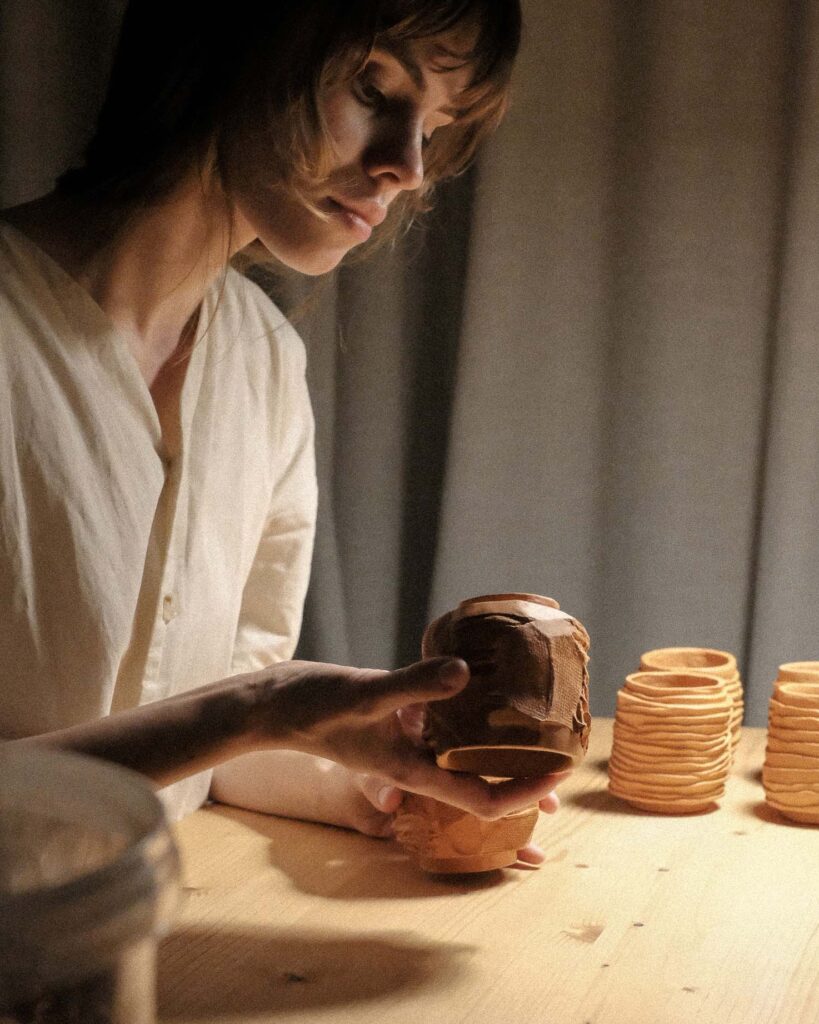
The studio
Nestled by the Baltic Sea in Lithuania, Ondõu is the ceramic practise of artist Greta Rekštytė. The name “Ondõu,” from the Samogitian word for “water,” reflects both the element’s role in shaping clay and the quiet influence it has on Greta’s process. Like water, her approach embraces fluidity, patience, and a balance between control and letting go.
The practise
The studio’s rhythm follows the hands. Each piece is hand-built slowly in small batches or as singular forms. A single work can take days across multiple stages, from carving to firing.
Traditional handbuilding techniques are central to the practice, most notably the Japanese kurinuki method — carving form from a solid block of clay. Many forms are left partially unglazed, allowing marks, textures, and surface irregularities to remain — not corrected, but embraced as part of the work. Made from durable stoneware and high-fired for strength, each piece is built to last — aging gracefully and becoming more personal with use.
Some pieces incorporate wild clay gathered and prepared by hand from the local landscape, used as slip or surface material — adding an unrepeatable connection to place.
The philosophy & kurinuki
Kurinuki is not just a technique — it is a way of thinking. Where most ceramic forms are built up, kurinuki begins with removal: a solid block of clay, and the slow, deliberate act of carving away everything that is not the form.
This process cannot be rushed. It demands presence, patience, and a willingness to listen to the material. The form is not planned in full — it emerges through the work itself, shaped as much by intuition as by intention.
For Greta, this mirrors something deeper: the idea that meaning lives not only in what is added, but in what is taken away. That there are things you must control — and things you must learn to let go. That empty space is not absence — it is part of the composition. That a crack or an uneven surface is not a flaw, but evidence of process, of time, of a human hand.
This same thinking carries through every piece — whether kurinuki or not. The material leads. The hands follow.
The artist behind
Before Ondõu took shape, Greta spent years working across creative fields — from fashion and art direction to branding and design. Clay came into her life early, first encountered at art school — an impression that stayed. It wasn’t a straight path, but the pull toward form, texture, and material kept returning.
Her deeper ceramics practice took shape in Berlin — studying under international ceramic artists and building a self-directed path through experimentation and material research. Returning to the Baltic coast brought new depth. Surrounded by local landscapes and slower rhythms, she began incorporating locally collected clays and developing a practice more rooted in place.
Collaborations
Alongside the studio’s ongoing collection, Greta works on select collaborations and commissions — for spaces, projects, and clients who value the story behind an object.
Objects made to live with — or to collect.
Between sculpture and function, control and letting go.
The studio
Nestled by the Baltic Sea in Lithuania, Ondou is the ceramic practise of artist Greta Rekštytė. The name “Ondou,” from the Samogitian word for “water,” reflects both the element’s role in shaping clay and the quiet influence it has on Greta’s process. Like water, her approach embraces fluidity, patience, and a balance between control and letting go.
The practise
The studio’s rhythm follows the hands. Each piece is hand-built slowly in small batches or as singular forms. A single work can take days across multiple stages, from carving to firing.
Traditional handbuilding techniques are central to the practice, most notably the Japanese kurinuki method — carving form from a solid block of clay. Many forms are left partially unglazed, allowing marks, textures, and surface irregularities to remain — not corrected, but embraced as part of the work. Made from durable stoneware and high-fired for strength, each piece is built to last — aging gracefully and becoming more personal with use.
Some pieces incorporate wild clay gathered and prepared by hand from the local landscape, used as slip or surface material — adding an unrepeatable connection to place.
The philosophy & kurinuki
Kurinuki is not just a technique — it is a way of thinking. Where most ceramic forms are built up, kurinuki begins with removal: a solid block of clay, and the slow, deliberate act of carving away everything that is not the form.
This process cannot be rushed. It demands presence, patience, and a willingness to listen to the material. The form is not planned in full — it emerges through the work itself, shaped as much by intuition as by intention.
For Greta, this mirrors something deeper: the idea that meaning lives not only in what is added, but in what is taken away. That there are things you must control — and things you must learn to let go. That empty space is not absence — it is part of the composition. That a crack or an uneven surface is not a flaw, but evidence of process, of time, of a human hand.
This same thinking carries through every piece — whether kurinuki or not. The material leads. The hands follow.
The artist behind
Before Ondou took shape, Greta spent years working across creative fields — from fashion and art direction to branding and design. Clay came into her life early, first encountered at art school — an impression that stayed. It wasn’t a straight path, but the pull toward form, texture, and material kept returning.
Her deeper ceramics practice took shape in Berlin — studying under international ceramic artists and building a self-directed path through experimentation and material research. Returning to the Baltic coast brought new depth. Surrounded by wild landscapes and slower rhythms, she began incorporating locally collected clays and developing a practice more rooted in place.
Collaborations
Alongside the studio’s ongoing collection, Greta works on select collaborations and commissions — for spaces, projects, and clients who value the story behind an object.
Objects made to live with — or to collect.